

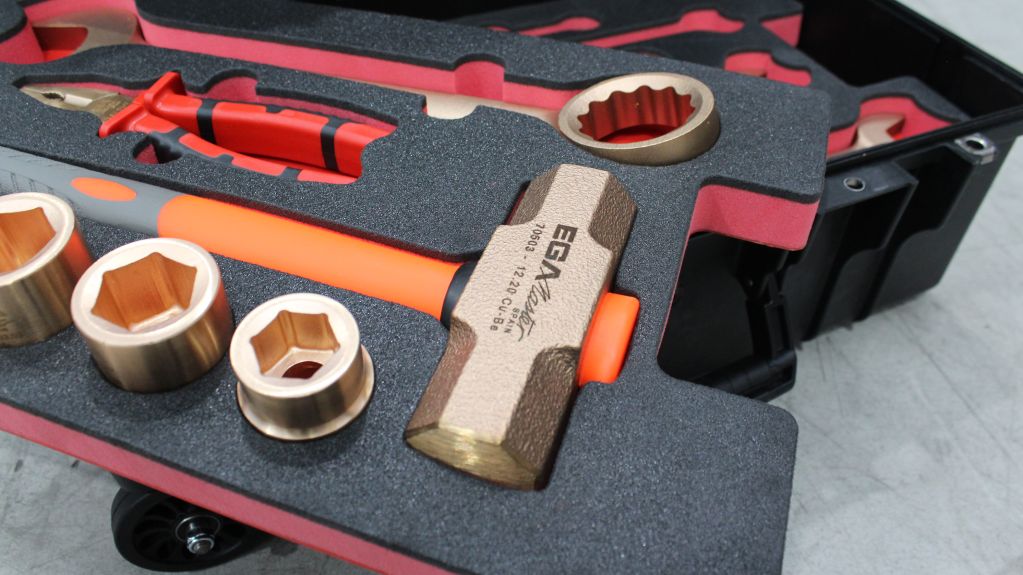
A non-sparking tool should not be selected solely for its color, price, or trade name. The choice should be based on the alloy, its mechanical properties, the task to be performed, and the assessment of ignition risks present in the workplace.
What alloys are used?
The most common alloys are copper-beryllium, Cu-Be, and aluminum-bronze, Al-Bron.
In EGA Master tools, Cu-Be has a declared hardness of 283-365 HB and tensile strength of 1,250 N/mm². Al-Bron reaches 229-291 HB and 800 N/mm². These are specifications specific to this range and should not be extrapolated to products from other manufacturers.
Cu-Be offers greater hardness and mechanical strength, making it suitable for frequent or stress-intensive work. Al-Bron may be sufficient in less demanding applications, provided it is compatible with the substances present and with risk assessment.
Conventional copper, brass, or bronze tools are considerably softer. They should not be considered equivalent substitutes, except when the operation expressly requires a low-hardness tool
What should be checked before buying?
A rigorous purchase specification must require:
- Alloy permanently identified and marked.
- Chemical composition and hardness range declared.
- Verifiable mechanical strength.
- Traceability of the manufacturer and the product.
- Test report applicable to the model or alloy purchased.
- Instructions for use, inspection, and chemical compatibility.
A test carried out by BAM can provide evidence about the alloy's behavior, but it should not automatically be described as an "ATEX certification" of the tool. Nor should a manual tool that is not covered by the relevant regulation be required to have an Ex or CE mark by default.
How should they be cared for?
Before use, cracks, deformations, burrs, and excessive wear should be checked. The tool must be kept clean and free of adhered ferrous particles. It must not be modified, welded, or ground without following the manufacturer's instructions.
These alloys are conductive: a spark-proof tool is not an isolated tool for electrical work. Furthermore, in the presence of acetylene, the material's compatibility must be expressly checked, as this gas presents additional risks of reaction and explosive decomposition.
Quality is not just about the tool reducing the risk of producing sparks. It must be possible to demonstrate what alloy it contains, how it has been tested, and why it is suitable for the intended operation.