

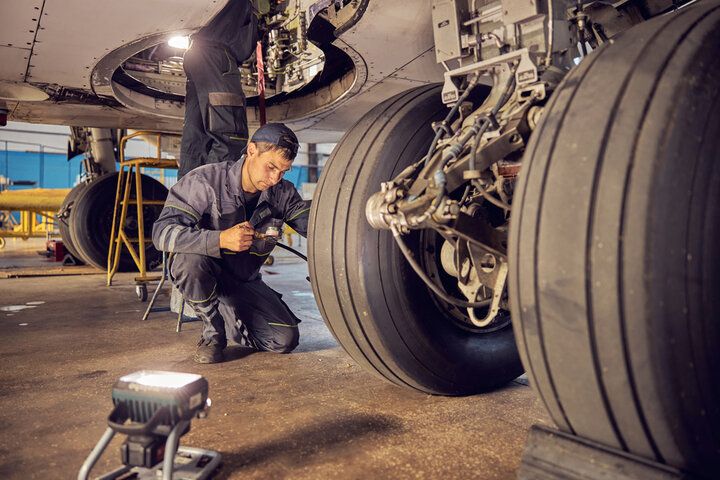
Line maintenance is the set of quick, routine and essential interventions that are carried out on an aircraft between flights or during short stays on the platform. Its purpose is to ensure that the aircraft is in optimal condition to operate the next leg without affecting the planned schedule.
It acts as an immediate safety barrier, detecting early failures, correcting minor incidents, and verifying basic systems before the next liftoff. Its agility allows operational continuity to be maintained without the need to immobilize the aircraft for long periods.
Highlights of line maintenance
1. Rapid and routine interventions
It includes activities that do not require deep dismantling or complex infrastructure, such as:
- Exterior visual inspections.
- Replacement of fluids (oil, hydraulic, drinking water).
- Replacement of LRU (Line Replaceable Units).
- Checking brakes, lights, tires and basic systems.
- Simple functional tests and resolution of small discrepancies.
These tasks are usually carried out on platforms or light hangars, under tight times and by certified technicians.
2. Focus on availability
Its objective is clear: to minimize delays, ensure punctuality and allow the aircraft to maintain its daily operational rhythm.
Line Maintenance vs AOG
An AOG (Aircraft On Ground) situation arises when an aircraft becomes inoperative due to an unexpected breakdown that prevents its flight until it is resolved. It is the most critical scenario for any airline, as it involves operational disruptions, lost revenue, and a direct impact on the customer experience.
What characterizes an AOG?
An AOG means that the aircraft is completely out of service. The priority is absolute: every minute generates significant losses. To solve it, the intervention of highly specialized teams and the use of rapid deployment AOG kits are required, designed to act in remote airports or without infrastructure.
Key Differences Between Online Maintenance and AOG
1. Urgency
- Line: High but integrated into daily operation.
- AOG: Maximum. Every minute of downtime costs money.
2. Type of intervention
- Line: Routine, predictable and low-complexity tasks.
- AOG: Critical and unexpected repairs that require immediate action.
3. Environment
- Line: Usual platform or service areas.
- AOG: Any airport in the world, even without technical support.
4. Tools
- Line: Basic kits adapted to recurring tasks.
- AOG: Complete and portable kits to deal with complex technical emergencies.
5. Impact
- Line: Maintains continuity and punctuality.
- AOG: It interrupts the operation and generates high costs.
The key to a strong aeronautical operation is knowing when to act routinely and when to respond with maximum urgency.
Line maintenance keeps the daily rhythm going, while effectively managing an AOG saves the operation. Having clear processes, adequate resources, and specialized kits makes the difference between a reactive operation and a truly resilient one. In such a competitive environment, that difference is what defines industry leaders.